











Zirconia Components ZrO2
Ceramic Milling Jars for Planetary Ball Mills
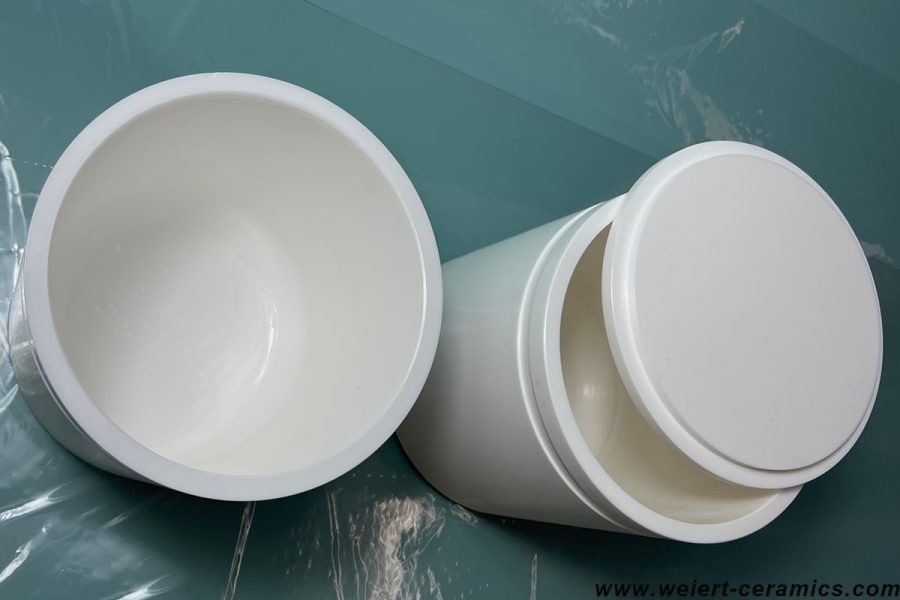
Low metal contamination · Sealed lid design · Direct manufacturer & custom solutions
| Nominal Volume | Typical Application | Lid Type |
|---|---|---|
| 1L | Small sample R&D | Sealed lid |
| 2 L | Lab testing | Sealed lid |
| 3 L | Material screening | Sealed lid |
| 4 L | Pilot lab use | Sealed lid |
| 5 L | Extended milling | Sealed lid |
As a direct manufacturer of ceramic milling jars, we support custom dimensions, lid structures, and sealing materials based on different milling machines and applications.
OEM and small-batch customization are available for R&D and pilot scale use.
How to Reduce Metal Contamination in Ball Milling: Why Zirconia Milling Jars Matter
Metal contamination is a common and often underestimated issue in ball milling , especially when processing high-purity powders, battery materials, and advanced ceramics. The choice of milling jar material plays a decisive role in determining both powder purity and experimental repeatability. Among available options, ceramic milling jars—particularly zirconia—have become the preferred solution for contamination-sensitive applications.
What Causes Metal Contamination in Ball Milling?
During ball milling, repeated impact and friction occur between the grinding media, the milling jar, and the material being processed. When metal jars such as stainless steel are used, abrasion inevitably introduces iron and other metallic elements into the powder.
This contamination may lead to:
- Changes in chemical composition
- Unwanted catalytic effects
- Altered phase behavior during sintering or heat treatment
For these reasons, how to reduce contamination in ball milling is a critical question in both laboratory research and industrial material development.
Why Use Ceramic Milling Jars Instead of Metal?
Compared with stainless steel jars, ceramic milling jars are widely used when metal contamination must be minimized.
Ceramic materials exhibit significantly higher hardness and chemical stability, resulting in much lower wear during milling.
Key advantages of a ceramic milling jar include:
- Extremely low metal contamination
- High wear resistance
- Excellent chemical inertness
- Suitability for both dry and wet milling
As a result, ceramic jars are widely adopted in advanced materials processing, where purity and consistency are essential.
Common Ceramic Materials for Milling Jars
Zirconia Milling Jars
Zirconia is widely recognized as the premium choice for contamination-sensitive milling.
A zirconia jar for planetary ball mill applications offers:
- Very low wear rate
- Minimal particle shedding during milling
- Stable performance in long milling cycles
These properties make zirconia particularly suitable for battery materials, electronic ceramics, and functional powders where even trace metal contamination can affect results.
Alumina Milling Jars
Alumina is a cost-effective ceramic material with good chemical stability.
Alumina milling jar chemical resistance is excellent in many acidic and alkaline environments, making it suitable for general ceramic powder processing. However, alumina typically exhibits higher wear than zirconia, which may introduce minor ceramic impurities during extended milling.
Zirconia vs Stainless Steel Milling Jar
A direct comparison highlights why zirconia is often preferred:
- Wear behavior: Zirconia shows dramatically lower wear than stainless steel
- Contamination risk: Stainless steel introduces metallic impurities; zirconia does not
- Application suitability: Zirconia is ideal for high-purity and research-grade materials
When contamination control is a priority, zirconia milling jars clearly outperform metal alternatives.
The Importance of Sealed Milling Jars with Lid
In wet ball milling, jar sealing becomes just as important as material selection. A grinding jar with lid, designed as a sealed milling jar, prevents slurry leakage and solvent evaporation during operation.
Sealed ceramic jars are essential for:
- Wet milling with solvents or dispersants
- Long milling durations
- Maintaining consistent slurry composition
Proper sealing not only improves safety but also ensures reproducible milling results.
Choosing the Right Milling Jar Material
Selecting the optimal milling jar depends on application requirements:
- For contamination-sensitive milling → Zirconia milling jar
- For general ceramic powder processing → Alumina milling jar
- For wet milling → Sealed ceramic grinding jar with lid
- For planetary mills → Precisely matched zirconia jars
Understanding the relationship between milling jar material, wear behavior, and contamination is the key to achieving reliable milling outcomes.
Custom Zirconia Milling Jars from a Direct Manufacturer
As a direct manufacturer of zirconia milling jars,
we provide sealed ceramic milling jars
for planetary ball mills and laboratory milling systems.
Custom volumes, jar dimensions, lid structures
and sealing solutions are available
for R&D, pilot-scale and OEM applications.
Weiert Ceramics Technology Co., Ltd.
- Contact Us
- Chalin Industrial Zone, Dingshu Town, Yixing City, Jiangsu Province
- sales@weiert-ceramics.com
- +86-199 52783126
Copyright © Weiert Ceramics Technology Co., Ltd. All Rights Reserved - Policy and Terms | FAQ | Sitemap